Overview
After finishing the book If You Can, I asked people on Reddit for recommendations for the next book that could help me better understand money and investing. The most suggested book was Broken Money, a book about how money works, how it evolved, and why the current monetary system has serious problems. Lyn Alden explains that money is not only an economic tool, but also a technology. As technology improves, the way humans store value, exchange value, and measure value also changes.
The book looks at money through history, economics, banking, geopolitics, and digital technology. Its main idea is that the modern financial system is “broken” because it depends heavily on debt, inflation, and currency debasement.
What Money Is
Alden begins by explaining the basic functions of money. Good money should work as a medium of exchange, a store of value, and a unit of account. However, not all forms of money perform these roles equally well.
Throughout history, people have used many different types of money, including shells, beads, silver, gold, paper notes, bank deposits, and digital money. Each form of money solved some problems but created new ones.
The book shows that money is essentially a ledger. It records who owns value and allows people to transfer that value across time and space.
The Evolution of Money
A major part of the book explains how money changed over time. Early forms of money were physical and scarce, such as gold and silver. These worked well as stores of value because they were difficult to produce.
Over time, banking systems developed. Banks made money easier to move and use, but they also introduced credit, leverage, and counter-party risk. Paper money made transactions more convenient, but it also separated money from physical scarcity.
Eventually, many countries moved away from gold-backed money and into fiat currency. Fiat money is not backed by a scarce asset. Instead, it depends on government authority, central banks, and public trust.
Why the Current System Is Broken
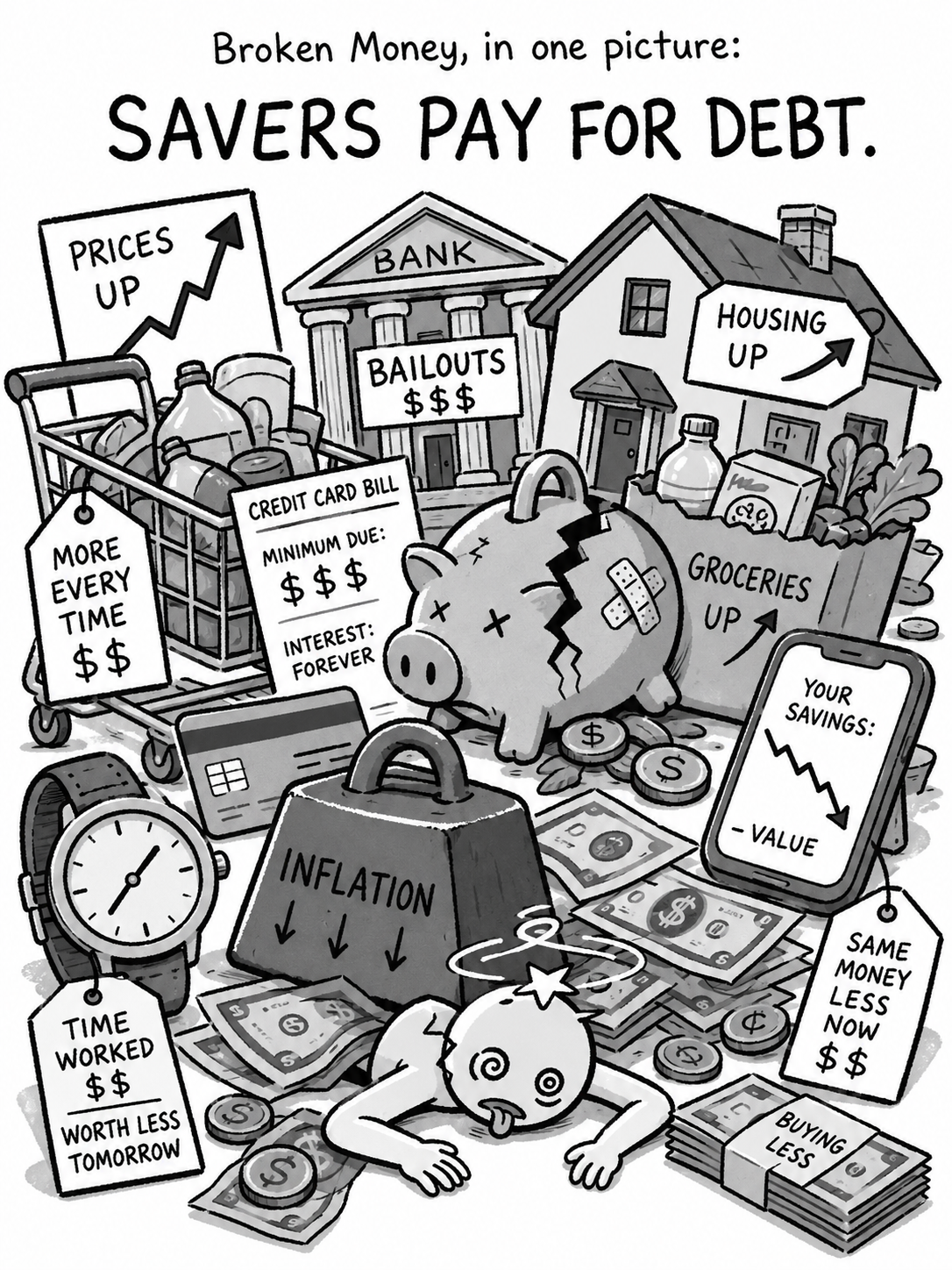
The central argument of Broken Money is that modern fiat money loses value over time. Governments and central banks can expand the money supply, especially during crises. This can help prevent short-term collapse, but it often creates long-term inflation and currency debasement.
As more money is created, the purchasing power of each unit of money falls. This means ordinary people need more money to buy the same goods and services. Wages may rise slowly, but prices of assets such as housing, stocks, and real estate often rise much faster.
This system benefits people who own assets and punishes people who mainly hold cash or earn wages. Savers lose purchasing power, while debtors and asset owners often benefit.
Debt and Inflation
Alden explains that debt is deeply connected to the modern monetary system. Today’s economies rely on credit growth. Governments, companies, and households all use debt to finance spending and investment.
However, when debt becomes too large, the system becomes fragile. Central banks often respond by lowering interest rates or creating more money. This may support the economy in the short term, but it can also push the system into more debt and more inflation.
This creates a cycle: more debt requires more money creation, and more money creation reduces the value of existing money.
The Global Impact
The book also focuses on how broken money affects different countries unequally. People in developed countries with strong currencies may not feel the problem as quickly. But people in developing countries or countries with weak currencies often suffer much more.
In these countries, inflation, devaluation, capital controls, and banking restrictions can destroy savings. People may work hard, save money, and still become poorer because their currency keeps losing value.
This is one of the most important points in the book: broken money is not just an abstract financial issue. It directly affects ordinary people’s lives.
Money, Power, and Control
Another key theme is the relationship between money and power. Centralized financial systems allow governments and banks to control money creation, payments, and access to the banking system.
This control can be useful in some situations, such as responding to financial crises. But it can also be dangerous because people’s savings and transactions depend on institutions they do not fully control.
Alden contrasts this with harder forms of money, such as gold and Bitcoin. These systems are harder to manipulate, but they also have their own limitations and trade-offs.
Bitcoin and Digital Money
In the later sections, Alden discusses Bitcoin, stablecoins, CBDCs, and other forms of digital money. She presents Bitcoin as a new type of monetary technology: digital, scarce, decentralized, and global.
The book argues that Bitcoin is important because it offers an alternative to fiat money. Unlike government currencies, Bitcoin has a fixed supply and does not depend on a central bank.
However, the book does not present Bitcoin as a perfect solution for every problem. Instead, it shows Bitcoin as part of a broader monetary evolution.
Key Takeaways
The biggest lesson from Broken Money is that money is not neutral. The design of a monetary system affects who gains, who loses, and how society stores value.
The book shows that inflation is not just rising prices. It is also a sign that money itself is losing purchasing power. Over time, this changes people’s behavior, investment decisions, and ability to build wealth.
Another important takeaway is that saving in a weak currency is risky. People need to understand the difference between nominal value and real purchasing power.
Short Review
Broken Money is a powerful and detailed book for understanding the problems of the modern financial system. Its strongest point is that it explains money as a system: part technology, part economics, part politics, and part history.
The book can feel slightly Bitcoin-focused in the later chapters, but its broader explanation of debt, inflation, and currency debasement is valuable even for readers who are not fully convinced about Bitcoin.
Overall, Broken Money is a highly useful book for anyone who wants to understand why money loses value, why asset prices rise over time, and why many people feel poorer even when the economy appears to grow.
Final Thought
The main message of Broken Money is simple but important: when money is built on too much debt and can be expanded too easily, savers eventually pay the price.
Rating: 4.5/5